Article
How to Structure an Accounting Firm Website With More Than One Service
A multi-service accounting firm site works when each service, office and team member gets a real page. Here is the structure that holds up.
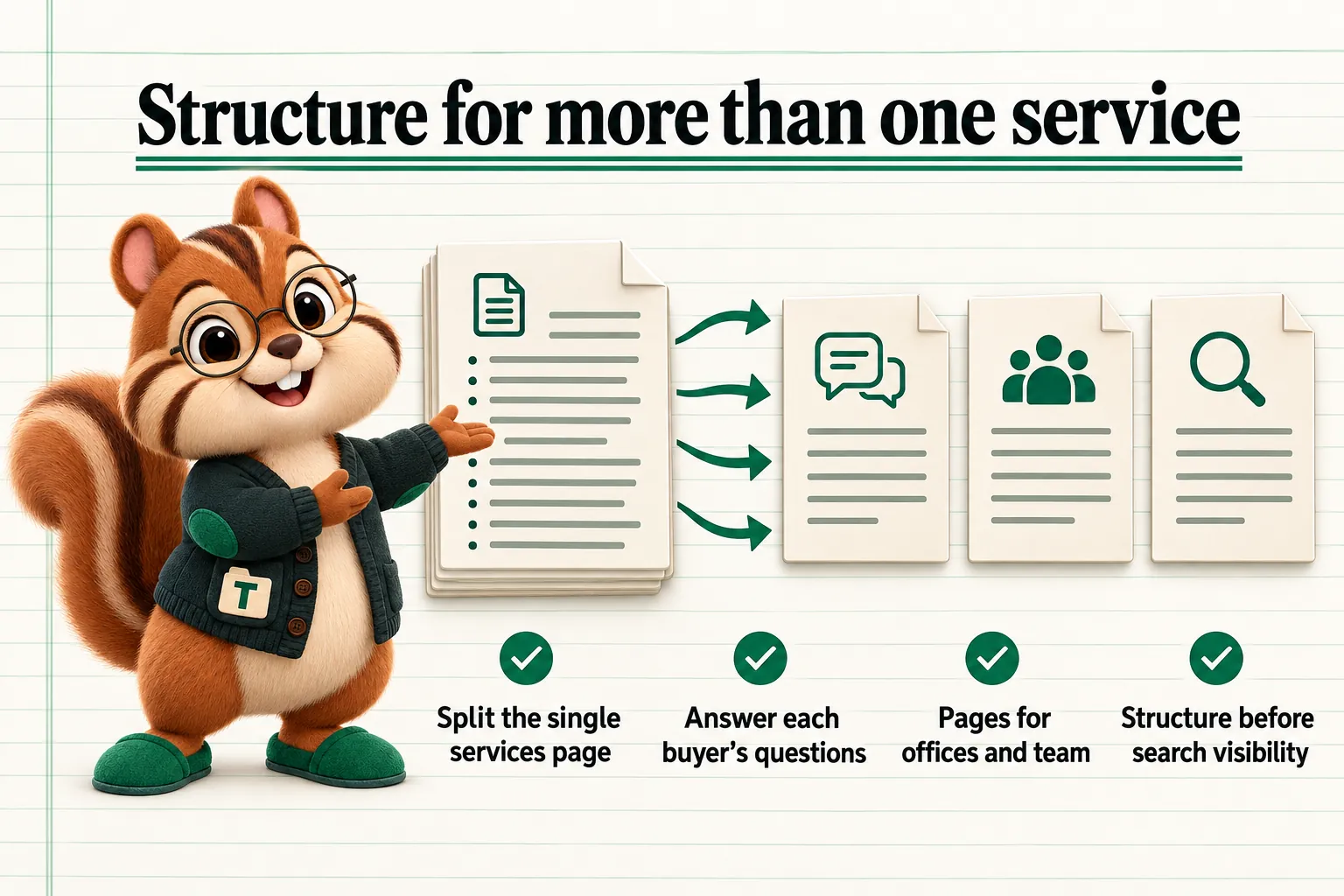
Most accounting firm websites fail for one structural reason: every service the firm offers is squeezed onto a single “services” page, so neither a search engine nor a visitor can tell what the firm actually specializes in. The fix is not a redesign or a new color scheme. It is giving each service, each office and each team member a real, dedicated page, built for the specific question that page needs to answer.
This matters more for accounting than for most local businesses, because a firm that does tax preparation, bookkeeping, payroll and advisory work is really running four (or more) distinct businesses under one name, each with a different buyer, a different search intent, and a different set of questions a visitor needs answered before they pick up the phone.
Why One “Services” Page Fails a Multi-Service Firm
A single services page fails because it forces every visitor, regardless of what they actually need, to read past content meant for someone else before finding their answer. A business owner searching for payroll help has to scan past paragraphs about tax preparation and audit support to find the two sentences that apply to them, if those sentences exist at all.
Search engines run into the same problem from a different angle. Google’s own documentation on how Search works describes crawling and indexing individual pages and matching them against specific queries. A page that tries to be relevant to five different searches at once is, by definition, less specifically relevant to any one of them than a page built for that single query would be.
The result on a typical firm site is predictable: the homepage or the one services page ranks, weakly, for a handful of broad terms, while every specific, high-intent search, “bookkeeping for a small retail business,” “payroll for a company with employees in two states,” “tax preparation for a single-member LLC,” goes to a competitor who happens to have a dedicated page answering exactly that.
The Page Structure That Actually Works
The fix is architectural, not cosmetic. Before writing a word of new copy, map out the pages your firm actually needs based on what you offer and how you are organized.
One Page Per Service, Not One Sentence Per Service
Every distinct service you bill for separately should have its own page. For most firms that means separate pages for things like tax preparation, monthly bookkeeping, payroll processing, and advisory or CFO-level work, rather than one page listing all four with a sentence each. Our own features page and pricing page follow this same principle: the offer is broken into its real parts rather than summarized into a single paragraph, because a buyer evaluating a specific piece of it wants depth on that piece, not a summary of everything.
A useful test: if you can imagine a client asking “does this firm do X,” and X is answered by a full sentence buried in a paragraph about something else, X needs its own page.
One Page Per Office, If You Have More Than One
A firm with more than one location should give each office its own page: address, hours, the team based there, and the services offered from that specific location. This is a structural decision as much as an SEO one. A search engine has an easier time understanding that a firm serves a particular city when there is a real page dedicated to that city’s office, rather than a shared “our locations” list that treats every office as a bullet point.
We build this way by default for the practice types we serve. Our CPA firm page and our bookkeeping services page each describe how office structure and page depth adjust for that specific kind of practice, because a two-partner bookkeeping shop and a six-partner CPA firm do not need the same number of pages, even though the underlying principle, one real page per distinct thing, is identical.
Team Pages That Do More Than List Names
A “meet the team” page with names, titles and a single group photo is a missed opportunity. Individual bio pages, each linked from the service pages that person actually works on, do two jobs at once: they let a prospective client see who they would actually work with, and they connect a real person to a real service in a way a search engine and a human reader both understand.
This matters even more for solo and small practices. A one-person enrolled agent practice competing against a large regional firm benefits disproportionately from a well-built individual page, because it is often the single strongest piece of evidence a visitor has that they would be working with a specific, competent person rather than a faceless service.
What Belongs on Each Service Page
Once the page exists, it needs the right content, not a shorter version of what used to be on the shared services page.
The Client Intake Form, Not a Generic Contact Box
A generic “send us a message” form asks a prospective client to guess what information you need to scope their engagement, and most people would rather give up than guess. A structured intake form that asks entity type, the specific service being considered, and a general timeframe produces an enquiry your firm can actually act on the moment it arrives, rather than a one-line message that starts every relationship with a round of clarifying emails.
Document Checklists and Software Lists
Two of the most common questions an accounting firm answers by phone are “what do I need to bring” and “do you work with the software I use.” Publishing clear, organized answers to both on the relevant service page removes an entire category of repetitive calls and reads as genuinely useful to a first-time visitor evaluating whether to reach out at all.
How This Structure Helps Search Visibility
A well-structured site is not a substitute for good content, but it is the foundation that lets good content actually get found. Google’s guidance on creating helpful, reliable, people-first content emphasizes building content around what real visitors are trying to accomplish, and a dedicated page per service is the most direct way to align a page’s content with a specific visitor’s specific intent.
Page speed plays a role here as well. Core Web Vitals, the set of user experience signals Google measures around loading, interactivity and visual stability, reward pages that load quickly and behave predictably, which is one reason every site we build carries a 90+ PageSpeed guarantee rather than treating speed as an afterthought to be audited later.
A Real Publishing Schedule Beats a One-Time Blog Push
Structure gets a firm’s site indexed properly. A consistent publishing schedule is what keeps it visible over time. A burst of ten articles published around launch and then abandoned signals, to both readers and search engines, that the site is not actively maintained. A modest, sustained schedule, two or three well-researched articles a week, sustained for months, builds visibility that compounds rather than a spike that fades.
This is also where a firm’s specific specialties matter. A practice that serves nonprofit organizations should be publishing about fund accounting and Form 990 preparation, not generic small-business tax tips, because that specific content is what a nonprofit board member searching for a specialist firm actually needs to find.
A Simple Before and After
The difference between a crowded single page and a properly structured site is easiest to see side by side. Here is what typically changes when a firm rebuilds around this structure.
| What visitors see | One shared services page | Dedicated pages per service |
|---|---|---|
| A visitor searching “payroll processing” | Lands on a general page and scans past tax and audit content | Lands on a page written specifically for payroll buyers |
| A visitor comparing your firm’s software support | Has to search the page or call to ask | Finds a dedicated software and systems section |
| A visitor in a second office’s city | Sees one address in a footer or a shared list | Finds a page built for that office, with its own team and hours |
| A new enquiry | Arrives as a one-line message with no context | Arrives through an intake form that already states entity type and service |
| An article about a specific specialty, like fund accounting | Has nowhere specific to link to | Links directly to the relevant service page, reinforcing both |
The pattern across every row is the same: specificity replaces generality, both for the visitor reading the page and for the search engine deciding which page to show for which query.
Handling a Redesign Without Losing What Already Works
Most firms considering this kind of restructure are not starting from a blank page. They already have a website, and some of its pages, even a crowded, general one, may already rank for a handful of terms and bring in some traffic. Rebuilding around dedicated service pages needs to account for that existing value rather than discarding it.
The safest approach is to treat the old page as source material rather than starting content, and to redirect its URL to whichever new, more specific page most closely matches what it used to cover. A shared services page that briefly mentioned bookkeeping should redirect to the new, dedicated bookkeeping page, not to the homepage, so that any existing links or bookmarks pointing at the old URL land somewhere relevant rather than on a generic landing page or, worse, a broken link.
This is also the right moment to fix problems the original site never addressed: a missing intake form, no office-specific pages, or content that describes services the firm stopped offering years ago. A redesign done properly is not just a visual refresh layered on top of the same structural problems. It is the point where the structural problems actually get fixed.
Local Structure Matters as Much as Service Structure
Everything said so far about services applies just as directly to location. A firm operating from a single office still benefits from a strong, specific local page, one with a real address, real hours, and content that naturally reflects the area it serves, rather than vague language that could describe a firm anywhere.
For a firm with more than one office, the stakes are higher. A shared “our locations” page that lists three cities in one paragraph gives a search engine almost nothing to work with for any of them individually. Splitting each office into its own page, with its own team and its own locally relevant content, is frequently the single highest-leverage change a growing, multi-office firm can make to its site, because it is solving the same underlying problem, one page trying to do too many jobs at once, at the location level instead of the service level.
Consistency matters alongside specificity. Your firm’s name, address and phone number should match exactly across your website, your Google Business Profile, and any directories your firm appears in. Mismatched details across these sources are a common, avoidable reason a otherwise well-built local page underperforms in search.
Why This Structure Also Helps With AI-Generated Answers
Search results increasingly include AI-generated summaries that pull directly from a page’s content to answer a specific question. A page built around a single, well-defined topic, “payroll processing for small businesses,” rather than a broad, mixed page covering five services at once, is easier for these systems to extract a clean, accurate answer from, for the same underlying reason it is easier for a human visitor to scan: the content maps cleanly to a single question instead of requiring the reader, or the system, to sort out which sentence answers which query.
This is not a separate strategy from the structure described above. It is the same structure paying off in a second channel. A dedicated page with a clear heading, an answer-first opening sentence, and a specific FAQ section relevant to that one service is well positioned for both a traditional search result and an AI-generated summary, because both are ultimately trying to match a specific question to a specific, well-organized answer.
What to Do If You Are Starting the Rebuild Today
If your current site has one crowded services page, here is the order we recommend for the rebuild:
- List every distinct service you bill for separately. If clients pay a different fee or sign a different engagement letter for it, it is a distinct service and deserves its own page.
- Rank those services by current revenue and by how often they are searched for individually. Build the highest-value pages first rather than trying to launch all of them simultaneously.
- Write each page around that service’s specific buyer, including the questions unique to that service, not a shortened version of a shared paragraph.
- Add a page for every office, with its own address, hours and team, if your firm operates in more than one location.
- Build individual team pages and link each one to the service pages that person actually works on.
- Replace your generic contact form with a structured intake form that asks the questions you actually need answered to scope a new engagement.
- Set a publishing schedule you can sustain, and stick to it for months rather than weeks before judging the results.
None of this requires starting over from scratch. Most firms can prioritize their two or three highest-value services, rebuild those pages properly, and expand from there over a matter of weeks rather than treating the whole site as a single, all-or-nothing project.
Where This Fits Into a Managed Build
Everything described here, one page per service, one per office, individual team pages, a proper intake form and a sustained article schedule, is what we build into every site on every plan, not an upsell added later. If you want to see what this looks like for your specific mix of services and offices, a demo is the fastest way to walk through it against your own practice rather than a hypothetical one.
Sources
Frequently asked questions
How many pages does a multi-service accounting firm actually need?
At minimum, one page per service you bill for, one page per office if you have more than one, a team page with individual bios, and a client intake path. A firm offering tax preparation, bookkeeping and payroll with two offices typically needs eight to twelve core pages before articles are added.
Should audit and assurance work be on the same page as tax preparation?
No. Audit, assurance, tax preparation and advisory are searched for separately and answer different client questions, so each should have its own page even if the same partners handle more than one of them.
Will splitting services into separate pages actually help us rank?
It gives a search engine a clear, specific page to match against a specific search, which is generally more effective than one broad page trying to rank for everything at once. It also gives a human visitor a page written for their exact situation instead of a paragraph they have to interpret.
What if we only offer one service today but plan to expand?
Build the one service page well now, and add pages as you add services. The structure described here scales in either direction without a rebuild, since each new service becomes a new page rather than an edit to an existing one.
Do enrolled agents and CPAs need different site structures?
The underlying structure, one page per service, one per office, individual team pages, is the same. What differs is the language: a page for an enrolled agent practice often needs to explain the credential itself, since fewer visitors already know what an EA does compared to a CPA.
Closing entry
Want a site built the way this article describes?
A live, 30-minute walk-through of the site GetAccountingWebsite would build for your firm.