Article
The Seasonal Shape of an Accounting Firm Website
An accounting firm's website has a busier half of the year and a quieter one. Planning content around that shape beats publishing at a flat rate.
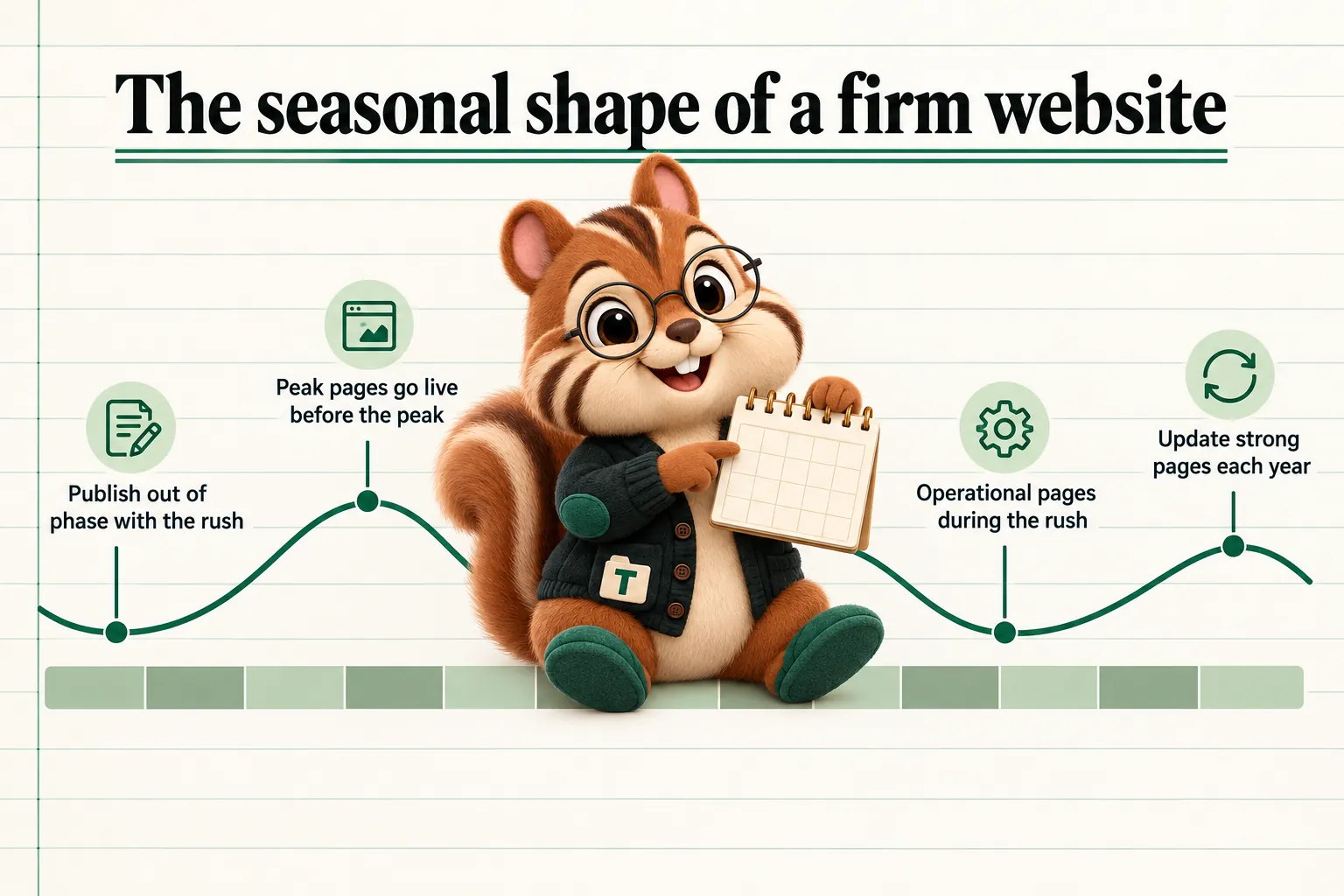
An accounting firm’s website does not behave like a plumber’s or a dentist’s. The people looking for it arrive in waves, and the waves are predictable. That predictability is the single biggest content planning advantage this profession has, and most firm sites throw it away by publishing at a flat rate all year, or by publishing only when somebody remembers.
The pattern is not a secret and it is not a statistic anyone needs to look up. Ask anyone who has worked a season in a practice and they will describe the same shape: a long ramp into the busiest weeks of the year, an abrupt drop afterwards, a secondary bump when extended work and mid-year planning arrive, and a quiet late-year stretch when the firm can think. The website follows the practice.
The Shape of the Year
Below is the shape most accounting practice websites follow. It is drawn as an illustration of the pattern rather than as measured data: there is no scale on it, and no figures are being claimed. What matters is the shape and what each part of it is for.
What each part of the year is for
| Month | What the site should be doing |
|---|---|
| Jan | Document checklists, how to book, what the firm needs and by when. Operational pages, not essays. |
| Feb | The peak of the season. Nothing new is written; existing pages are kept accurate and reachable. |
| Mar | Highest demand on the site. Contact routes, turnaround expectations and status pages carry the load. |
| Apr | The tail of the rush, plus the first enquiries from people who left it late and want a firm for next year. |
| May | The drop. The best month of the year to start writing the deep pages for the next cycle. |
| Jun | Bookkeeping, payroll and advisory pages: the parts of the practice that are not seasonal at all. |
| Jul | Service page rewrites, process explanations, the material that takes a week and lasts three years. |
| Aug | Mid-year planning content, and the first pieces aimed squarely at the coming season. |
| Sep | The secondary bump. Extended work and business filings bring a different, better informed visitor. |
| Oct | Year-end preparation material, aimed at businesses rather than individuals. |
| Nov | Publish the season pages now so they are found later. Review last year and revise rather than duplicate. |
| Dec | Quiet on the site, loud in preparation: pricing, intake, booking and checklists all get checked before January. |
A note on what this chart is and is not. It describes the rhythm of traffic to a firm’s own website and the firm’s own publishing schedule. It is not a statement about anyone’s filing obligations, and no date on it should be read as a deadline. Anything in that territory belongs with the practice and its client, not on a marketing page.
Why Flat Publishing Underperforms
Publishing the same volume of the same kind of content every month feels disciplined. In this niche it usually underperforms, for two reasons.
The first is timing. A page that answers a question people ask in the busiest weeks needs to already exist and already be discoverable when those weeks arrive. Google’s documentation on how Search works describes crawling, indexing and serving as distinct stages, and none of them are instantaneous. Publishing a piece into the middle of the rush is publishing it after the audience has already searched.
The second is attention. The weeks when a practice has the least capacity to write well are exactly the weeks a flat schedule demands a new piece. What gets published in those weeks is thin, because the people who know the subject are working sixty hour weeks. Thin content published under pressure is the clearest possible demonstration of why an editorial calendar should bend around the practice rather than ignore it.
What to Publish During the Rush
During the peak, the website has one job: remove friction. Nobody arriving in the busiest weeks wants a 3,000 word analysis. They want to know four things, and every one of them is a page rather than an article.
What you need from me. A document checklist, written plainly, organised by situation, that a client can open on a phone and work through. This is consistently among the most useful pages an accounting site can carry, and it is also the page that reduces the number of back and forth emails the practice has to send.
How do I get in. Whether the firm is accepting new clients, what the current turnaround looks like, and the actual mechanism for booking. A firm that is temporarily full should say so on the site. It reads as competence, not as weakness, and it stops the practice from fielding enquiries it cannot serve.
Where is my work. If there is a client portal, the route into it should be obvious from the homepage during the season. If there is not one, the page explaining how the firm communicates during busy periods does the same job.
Who do I talk to. A named route to a human. Not a general inbox alone.
None of these are new articles. They are existing pages that should be reviewed, made accurate, and pulled forward in the navigation for the season, then pushed back afterwards.
What to Publish in the Quiet Months
The quiet stretch is when the site gets its structural work done. This is when the pages that take real effort should be written, because they are the pages that still earn attention two or three years later.
The Service Pages Nobody Has Rewritten Since the Site Launched
Most firm sites carry service pages written once, by whoever built the site, from a paragraph the partner emailed over. Rewriting one properly takes a few hours with someone who actually does the work, and it changes the page from a description into an answer. The structural case for one page per service is covered in our article on structuring a multi-service firm website, and the quiet months are when that structure actually gets built.
The Non-Seasonal Side of the Practice
For most practices, the strategic goal is a bigger share of revenue that does not depend on a ten week window. Monthly bookkeeping, payroll, and advisory or fractional CFO work are all bought year round by people who are not thinking about a season at all.
That work needs its own pages, written for its own buyer, and the quiet months are the only time anyone has the capacity to write them. A firm that spends one quiet summer building out its bookkeeping and advisory pages properly is a firm with a different traffic shape a year later.
The Pieces Aimed at the Coming Season
Anything intended to be useful during the peak should be written and published in the preceding quiet months. That gives it time to be discovered, time to be linked to, and time for the firm to notice what is missing and fix it before it matters.
Updating Beats Republishing
Every year, the same question arrives: do we write a new version of last year’s piece, or update the existing one?
In almost every case, update. A page that has been live for a year, has been linked to, and has built up some history is a stronger starting point than a new page with none of that. Revising it keeps that history and improves the answer. Publishing a near duplicate beside it splits the value between two pages and leaves a stale one behind.
A practical routine that works:
- Pull the list of pages that carry anything time sensitive.
- For each, decide whether it is still the best answer the firm can give.
- Revise the ones that are, and note on the page that it was reviewed.
- Retire or redirect the ones that are not, rather than leaving them live.
- Only write something new when the question itself is new.
Step four is the one firms skip. A site that accumulates five years of near identical seasonal pages is harder to navigate, harder to maintain, and gives a visitor five chances to land on the worst version.
Building the Calendar
A workable annual calendar for an accounting practice has three tiers rather than one.
Tier one, the permanent pages. Services, offices, team, pricing, intake, checklists, contact. Reviewed on a schedule, rewritten rarely, never allowed to go stale. These carry the majority of the site’s value and almost none of its publishing effort.
Tier two, the deep articles. Written in the quiet months at a pace the practice can genuinely sustain. Two a month written well beats four a month written badly, and the difference compounds because the good ones keep earning.
Tier three, the operational updates. Short, timely, and concentrated in the weeks around the peak. Turnaround notices, capacity updates, checklist revisions, booking changes. These need no research, take minutes, and are the most read pages on the site during the weeks they matter.
The mistake is treating all three as the same activity and putting them on the same schedule. They have different authors, different research needs, and different value, and the calendar should reflect that.
What This Looks Like Running
On the sites we build and manage, the publishing schedule is agreed against this shape rather than against a flat count. Articles are written ahead of the period they are aimed at, the operational pages are pulled forward in the navigation as the season arrives, and the deep work is scheduled into the months when the practice can contribute to it properly.
That is also why the filing calendar on our own home page frames its months as our scheduling guidance about website traffic rather than as a statement about anybody’s obligations. The distinction matters. A website company can say a great deal that is useful about when a firm’s visitors show up and what they will be looking for. It should say nothing at all about what any particular business owes, or when.
The Secondary Bump Is the One Firms Miss
Almost every practice plans for the main peak. Far fewer plan for the second, smaller rise later in the year, and it is frequently the more valuable of the two for a firm trying to change its client mix.
The visitor arriving in that period is different. They are often a business rather than an individual, they are usually working to a longer horizon, and they have had time to be dissatisfied with whoever they used last. They are also, in practice, far more likely to be shopping for an ongoing relationship rather than a single piece of work, which is exactly the client a practice trying to build recurring revenue wants to meet.
Content aimed at that visitor looks nothing like content aimed at the main peak. It is comparative rather than operational. It explains how the firm works across a year rather than what to send and when. It addresses the questions a business owner asks when they are considering changing advisers: what the transition looks like, who they will actually deal with, how often they will hear from the firm, what happens to the records held elsewhere, and how quickly the firm can pick up work that is already part way through.
A practice that writes three genuinely good pages for that audience, and publishes them in the preceding quiet weeks, has something working for it during a period most competitors treat as downtime.
Do Not Let the Calendar Outrun the Practice
There is a failure mode on the other side of flat publishing, which is an ambitious calendar that nobody can sustain. It usually shows up in the second quarter of the plan, when the pieces get shorter, the research gets thinner, and eventually the schedule is quietly abandoned.
Two safeguards help.
Decide the floor, not the ceiling. Agree the smallest amount the practice can definitely produce in its worst month, and make that the commitment. Anything beyond it is a bonus rather than a failure to hit target. A firm that reliably publishes two strong pieces a month for three years is in a far better position than one that published eight a month for a quarter and then stopped.
Separate writing from reviewing. The expensive input from a practice is not writing, it is judgement. A partner who will not write two thousand words will happily spend twenty minutes correcting them. Structuring the process so the professional reviews rather than drafts is usually the difference between a calendar that survives and one that does not.
It is also worth being honest about what the firm is actually able to say. Anything that moves from explaining how a practice works into telling a reader what to do about their own situation is a different kind of writing with different obligations attached. The safest and, as it happens, the most useful editorial line is to write about the firm’s process, its scope and its experience, and to leave anything that constitutes guidance for a specific client to the engagement itself. The IRS maintains its own reference material for tax professionals, and pointing a reader to a primary source is nearly always better than paraphrasing one.
Measuring the Shape Rather Than the Month
The final piece is measurement, and the mistake here is to judge a seasonal site month against month. A site whose traffic falls by half after the peak has not got worse. It is doing exactly what it should.
Three comparisons are more useful than month on month.
The same period last year. The only fair comparison for a seasonal business, and the one that shows whether the work done in the quiet months actually landed.
The floor rather than the peak. The quiet months are where growth in the non-seasonal side of the practice shows up first. If the quiet months are rising year on year, the bookkeeping and advisory pages are working, whatever the peak did.
The mix of pages. Watch which pages carry the traffic. A site where the peak is carried by checklists and booking pages and the quiet months are carried by service pages is a healthy one. A site where a single page carries everything is fragile, whatever its totals look like.
Search Console’s own comparison tools handle the first two of these without any additional setup, and the third is a question of reading the page level report rather than the summary. None of this needs a dashboard, and none of it needs to be looked at more than quarterly. The rhythm of the year is slow enough that weekly monitoring tells a firm nothing except how to worry.
One Calendar, Reviewed Once a Year
A final practical note. The calendar itself should be a single page that the practice can actually see, not a plan that lives in one person’s head or in a document nobody opens.
What belongs on it is short: the twelve months, what tier of work happens in each, who is responsible, and the two or three deadlines that are genuinely fixed. What does not belong on it is a title for every piece of content for the next year, because those titles will be wrong by the second quarter and an out of date plan gets abandoned faster than no plan at all.
Review it once, at the same point each year, in the quiet stretch after the main peak. That review has three questions. Did the work we planned for the quiet months actually happen? Did the pages we wrote for the season get found when the season arrived? And what did people ask us this year that the site did not answer? The answers to the third question are usually the next year’s best content, and they cost nothing to collect because the practice has already been given them, one enquiry at a time.
Where to Start
If the site currently has no calendar, the first move is not to plan twelve months. It is to pick the next quiet stretch and commit it to one thing: the service page for whichever part of the practice the firm most wants to grow. Write it properly, with someone who does that work sitting next to whoever is writing. Publish it, link to it from the pages that already get traffic, and leave it alone.
Then do the same thing the following quarter. Within a year the site has a spine of pages that are genuinely the firm’s best answers, and the seasonal work becomes a matter of keeping a handful of operational pages sharp rather than an annual scramble to produce something, anything, before the rush.
Sources
Frequently asked questions
Should we stop publishing during our busy season?
No, but the type of publishing should change. During the busiest weeks the useful pages are operational: what documents you need, how to reach the firm, what turnaround looks like right now. Long analytical pieces are better written in the quiet months and simply promoted during the busy ones.
How far ahead does content need to be published to be useful in a busy period?
Earlier than most firms expect. A page has to be discoverable before the searches arrive, and discovery is not instant, so work aimed at a busy period is generally written and published in the preceding quiet months rather than during the period itself.
Is evergreen content or seasonal content more valuable for an accounting firm?
Evergreen content carries the year and seasonal content captures the peak. A practical split is a stable base of service and process pages that stay useful all year, plus a smaller set of pages refreshed each season rather than rewritten from scratch.
Should the same article be republished every year with a new date?
Updating a page that is genuinely still the best answer is usually better than publishing a near duplicate beside it. Revise the content, note what changed, and keep one strong page rather than accumulating several weak ones competing with each other.
What should a firm publish in its quietest months?
The work that pays off later: the deep service pages, the process explanations, the document checklists, the pieces aimed at the practice's advisory or bookkeeping side, and the pages that support whichever part of the business the firm wants to grow when the seasonal rush is not setting the agenda.
Closing entry
Want a site built the way this article describes?
A live, 30-minute walk-through of the site GetAccountingWebsite would build for your firm.