Article
A Bookkeeping Service Page That Books Calls
A bookkeeping page fails when it describes the service instead of the client's situation. Here is the anatomy of one that books calls.
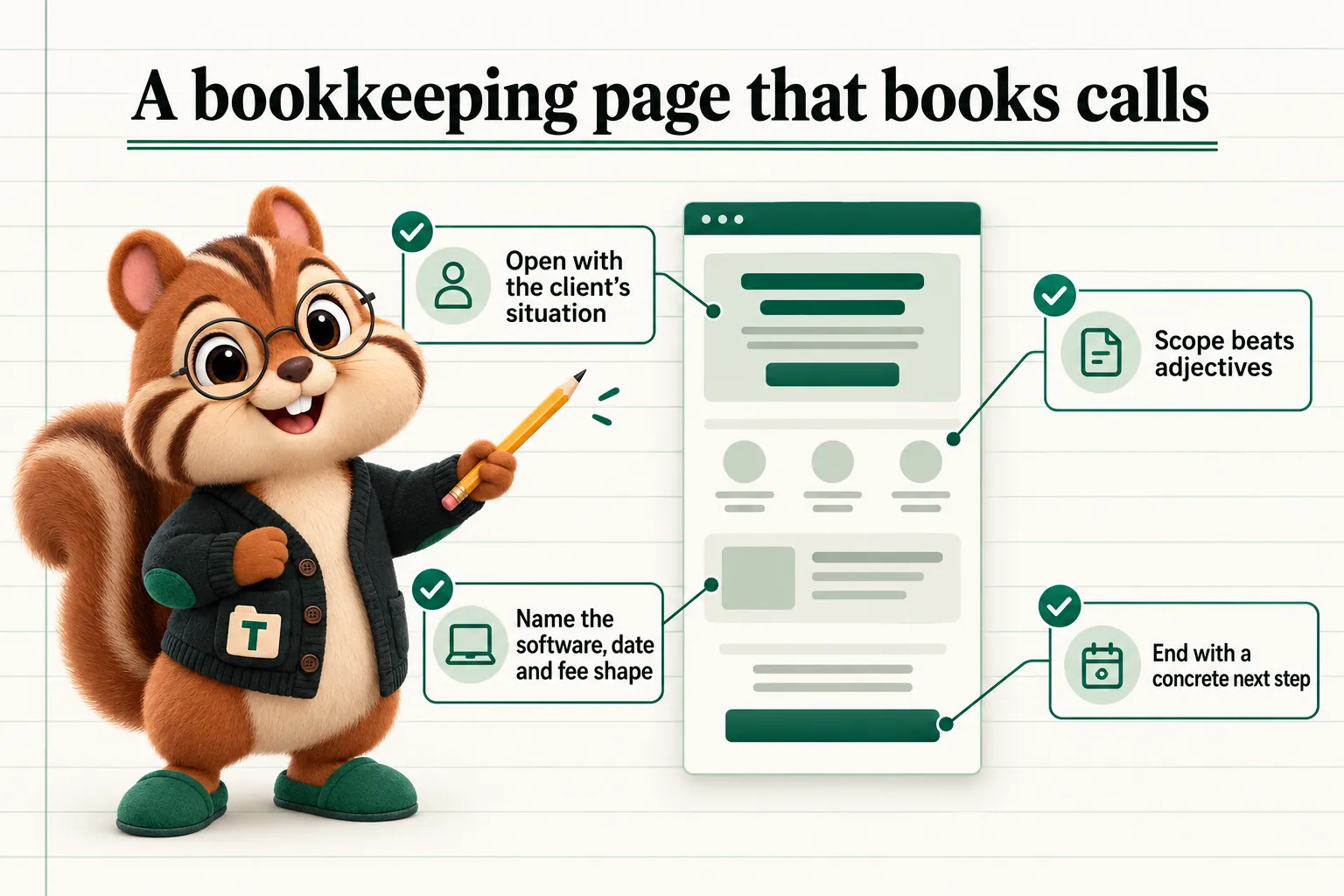
Most bookkeeping service pages read like a definition of bookkeeping. They explain that accurate books are important, that reconciliation matters, and that the firm is experienced and detail oriented. Every competitor’s page says the same thing, which means the page does nothing to help a visitor choose.
A page that books calls does something different. It describes a situation the reader recognises as their own, states plainly what the firm would do about it, and tells them exactly what happens if they get in touch. That is the whole job. Everything below is the structure that gets there.
Start Where the Reader Is, Not Where the Service Is
The first paragraph decides whether the rest of the page is read. Most firm pages spend it on the firm. A better opening spends it on the reader.
Compare two openings. The first: “Our bookkeeping service provides accurate, timely financial records so you can make informed decisions about your business.” The second: “If your books are three months behind, your bank feed has stopped matching, and you are not sure whether last quarter’s numbers are right, this page describes what we would do about it and roughly what it costs.”
The second opening is not cleverer. It is simply about something. It names a recognisable state, and a reader in that state keeps reading because the page has just demonstrated that it knows what is going on.
This is also what Google’s guidance on helpful content is describing when it asks whether a page leaves a reader feeling they have learned enough to achieve their goal. A definition of bookkeeping teaches a business owner nothing they did not already know. A description of what happens to their specific mess does.
Write for One Situation Per Page
A single page cannot open where the reader is if the reader could be in four different places. A firm offering monthly bookkeeping, catch-up work, controller services and year-end support needs separate pages for each, because each one opens in a different place:
- Monthly bookkeeping opens with a business that has outgrown doing it themselves.
- Catch-up opens with a business that is behind and slightly embarrassed about it.
- Controller or advisory work opens with a business whose books are fine but whose reporting is not.
- Year-end support opens with a business whose accountant needs something it cannot produce.
Those are four different readers. Putting them on one page means the opening paragraph has to be generic, and generic openings are the ones that get skimmed past.
Scope Is the Content
After the opening, the reader wants to know what they are actually buying. This is where most pages reach for adjectives and where the strongest pages get specific.
Write scope as a list of things that happen, on a schedule, with an owner. For a monthly bookkeeping engagement that might read:
- Bank, credit card and merchant accounts reconciled monthly.
- Transactions coded to an agreed chart of accounts, with a query list for anything unclear.
- Accounts payable and receivable maintained if in scope, with a named cut-off each month.
- A month-end pack delivered by an agreed working day, including the statements the client actually reads.
- A short monthly review call, or a written summary if the client prefers.
- Year-end file prepared and handed to whoever prepares the return.
Say What Is Not Included
The out of scope list is more persuasive than the in scope list, because almost nobody writes one. A page that says plainly that payroll is quoted separately, that inventory counts remain with the client, that the service does not include representation, and that tax filing is either separate or subcontracted, reads as a firm that has thought about its own boundaries.
It also prevents the most common cause of an unhappy first quarter, which is a client who assumed something was included because the page never said it was not.
Say What the Client Still Has to Do
Every bookkeeping engagement depends on the client doing something: sending statements, answering queries, approving a chart of accounts, getting receipts in by a date. Saying so on the page is not off-putting. It is the clearest possible signal that the firm has run this engagement before, and it sets up the working relationship correctly from the first read.
The Three Filters Buyers Apply Immediately
Before a business owner cares about the firm’s philosophy, they check three things. If the page does not answer them, they open a second tab.
Software. Name what the practice works in. A business already running on a particular ledger will filter on this within seconds, and a firm that hides it forces the question into an email. Say which platforms are supported, whether the firm will work in a client’s existing system, and, crucially, who holds the subscription and what happens to it if the relationship ends. That last point causes more friction at the end of engagements than almost anything else and answering it up front is a genuine differentiator.
Timing. When does the month close, when does the pack arrive, and how quickly does the firm respond to a question in between. “Month end pack by the tenth working day” is a commitment. “Timely reporting” is not.
The shape of the fee. Not necessarily a number, but the structure. Monthly and fixed, or hourly, or banded by transaction volume. A reader deciding whether to call wants to know whether they are buying a subscription or an open meter. Our article on what belongs on a pricing page goes into how much to publish and what to do when the firm cannot publish figures at all.
Handle the Switching Objection Directly
The majority of people reading a bookkeeping page already have a bookkeeper, an accountant, or a spouse doing the books. The page has to deal with that, and most do not.
The objections are predictable and each deserves a short, plain answer:
“Switching sounds like a lot of work.” Describe the transition. What the firm needs, how long it takes, and what the client has to do during it. A named number of steps beats reassurance.
“I do not want to have an awkward conversation with my current bookkeeper.” Say whether the firm handles the handover, and what it does and does not do on the client’s behalf.
“What if my records are in a mess?” This is the objection behind a large share of unstarted enquiries. A sentence confirming that nobody is going to be judged, and that the firm has seen worse, removes a real barrier.
“What happens to my data if we part ways?” Answer it plainly: what the client gets, in what format, and how quickly. A firm confident enough to write its exit terms on its marketing page is making a strong statement about how it expects the relationship to go.
Proof Without Invention
Proof on a bookkeeping page is difficult because the best proof, a named client with numbers attached, is usually confidential. That constraint is not a reason to invent something.
What works, in order of strength:
A named client with permission. Rare and worth pursuing. If a client agrees, the useful quote is not “they are great to work with,” it is a description of the situation before and after in the client’s own words.
An anonymised engagement described in detail. “A two location retail business, eighteen months behind, brought current across a defined period” is credible precisely because it is specific about everything except identity.
The firm’s own process, stated as fact. How many sets of books the team handles, what the typical onboarding takes, what the month end schedule is. These are facts about the practice and need no third party to verify.
What does not work is an invented testimonial, an unearned star rating, or a client count nobody can support. Beyond the honesty problem, these are the elements a sceptical reader checks first, and finding one that does not hold up costs the whole page its credibility.
Structure the Page So It Can Be Skimmed
Nobody reads a service page in full on the first pass. They scan headings, stop at something relevant, and read one section. That makes heading structure a conversion feature, not a formatting choice.
Some practical rules:
- One heading per question the reader actually has, phrased the way they would ask it.
- Headings in order, with no level skipped, so the page is navigable by assistive technology as well as by eye. The WCAG guidance on structure exists for this reason, and it happens to produce a better page for everyone.
- The first sentence under each heading answers that heading. If a reader stops at that sentence and leaves, they should still have the answer.
- Short paragraphs, and lists only where the content is genuinely a list.
- No section that exists only to contain a keyword.
End With the Next Step, Not a Form
The final section of a service page should tell the reader what happens if they act. Specifically:
- What they click or fill in, and how long it takes.
- What information to have ready. For bookkeeping this is usually the software in use, roughly how many accounts and transactions, and how far behind things are.
- Who replies and how quickly.
- What the first conversation covers, and whether it costs anything.
- What the outcome of that conversation is: a quote, a scoping call, a proposal.
This section is often the difference between a page that gets read and a page that gets acted on. A visitor who has decided they want to talk to the firm still has to overcome the small uncertainty of not knowing what they are starting. Removing that uncertainty is cheap and almost nobody bothers.
A Working Outline
Put together, a bookkeeping service page that books calls tends to look like this:
- The situation, in the reader’s words.
- What we do about it, as a scope list.
- What is not included, and what stays with you.
- Software, timing and how the fee is structured.
- How switching works, including records and exit.
- Who this is and is not for.
- Proof, honestly framed.
- Questions people ask before they call.
- What happens next, in numbered steps.
The order matters more than the wording. Scope before price, objections before proof, and the next step as its own section rather than a button floating at the bottom.
Who This Is Not For
The section almost no firm writes, and the one that does the most filtering, is an honest statement of who the service does not suit.
A practice that says “we work best with service businesses between five and fifty employees who want a monthly close rather than a quarterly one, and we are not the right fit for pre-revenue startups or for businesses looking for the cheapest possible option” has done two useful things at once. It has told its ideal client that the page was written for them specifically, and it has given everyone else permission to leave without occupying a partner hour first.
Firms resist this because it looks like turning away work. In practice it changes the composition of the enquiries rather than the volume, and the enquiries that survive it are substantially easier to convert, because the reader has already agreed with the firm’s description of itself before making contact.
There is a way to write it that does not read as arrogance. Frame it as fit rather than as quality: not “we only work with serious businesses” but “the monthly close we run assumes a certain volume of activity, and below that the fee is hard to justify for the client.” The first is a boast. The second is a fact about the economics of the engagement and reads as such.
Write the Page With Someone Who Does the Work
The gap between a page that sounds like a bookkeeping firm and a page that sounds like this bookkeeping firm comes almost entirely from who was in the room when it was written.
A marketing writer working from a brief produces accurate, generic copy, because generic is what a brief contains. A page written from a conversation with the person who actually runs the monthly close contains the details that make it credible: the specific query that always comes up in month two, the reason the pack is delivered when it is, the category of transaction that always needs a call, the thing clients are always surprised by.
The practical method is an hour of recorded conversation and a set of questions:
- Walk me through the first thirty days of a new client.
- What do you always have to ask for twice?
- What do clients think they are buying that they are not?
- What is the most common reason an engagement goes badly?
- What does a good client do that a difficult one does not?
- What do you wish people knew before they called?
The answers to those six questions, lightly edited, are most of a service page. They are also impossible to get from a competitor’s site, which is why a page written this way stops looking like every other page in the sector.
Keep the Page Alive
A service page is not finished at publication. It should change as the practice changes, and the two events that most often require an edit are a change in scope and a repeated question.
Scope drift is the dangerous one. A firm gradually starts including something it never priced for, and the page never catches up, so new clients arrive expecting the newer, broader version. Reviewing service pages against what the team actually delivers, once or twice a year, catches this before it becomes an awkward conversation.
Repeated questions are the productive one. Every question that comes up on a first call more than about three times is a question the page failed to answer. Adding it, in the visitor’s own words, does two things: it shortens the next call, and it gives the page another genuine answer that someone might be searching for. Over a couple of years of doing this consistently, a service page accumulates into the most complete answer on the subject that the firm’s market can find anywhere, which is exactly the position worth occupying.
Where the Page Sits in the Site
One last structural point. A strong bookkeeping page needs somewhere to send people and something linking to it. The catch-up page, the payroll page and the advisory page should all reference it where relevant, and it should link out to them rather than trying to absorb their content.
That is the same principle described in our piece on structuring a firm site with more than one service: each page answers one question completely and points at its neighbours, rather than every page trying to answer everything. Written that way, a bookkeeping page stops being a brochure section and becomes the page that does the firm’s selling while the practice gets on with the work.
Sources
Frequently asked questions
How long should a bookkeeping service page be?
Long enough to answer the questions a buyer has before they call, which for most practices means somewhere between eight hundred and two thousand words. Length is a symptom rather than a target: a page that answers scope, fit, price shape, process and objections honestly tends to land in that range on its own.
Should the page target a keyword or a client?
A client, in the language that client uses. The phrase people search and the phrase a firm uses internally are often different, and the page should be written in the visitor's words. A page written for a real situation almost always covers the search phrase naturally.
Do we need a separate page for catch-up work?
Usually yes. Catch-up and clean-up work is bought by someone in a different state of mind from someone shopping for an ongoing monthly service, and the questions are different enough that combining them makes both weaker.
What is the single most common thing missing from a bookkeeping page?
What happens next. Many pages describe the service in detail and then end at a generic contact form, leaving the visitor to guess how the first conversation works, how long it takes and what they need to have ready.
Should the page name the accounting software the firm uses?
Yes, if the firm is genuinely committed to it, because software is one of the first filters a business owner applies. Name what you work in, say whether you can work in something else, and be clear about who holds the subscription, since that question causes more friction later than almost anything else on the page.
Closing entry
Want a site built the way this article describes?
A live, 30-minute walk-through of the site GetAccountingWebsite would build for your firm.